The 2025 Wisconsin Supreme Court election was held on April 1, 2025, to elect a justice of the Wisconsin Supreme Court for a ten-year term. Dane County circuit judge Susan M. Crawford defeated Waukesha County circuit judge and former state attorney general Brad Schimel, maintaining the liberal 4–3 majority on the court.
Incumbent justice Ann Walsh Bradley chose to retire after 30 years on the court; she had been identified as a liberal and voted consistently with the liberal 4–3 majority on the court. Crawford was identified as the liberal candidate in this election, and received support from the Democratic Party of Wisconsin and Democratic Party-aligned donors. Schimel was identified as a conservative and was supported by the Republican Party of Wisconsin and Republican Party-aligned donors.
The election received significant national media attention and became the most expensive judicial race in history, with total spending approaching $100 million. Interest in the election was also intensified due to the involvement of billionaire Elon Musk, who at the time of the election was serving as a senior advisor to U.S. President Donald Trump and was the owner of one of the largest social media companies in the world. Musk spent more than $25 million supporting Schimel through political action committees; he also tweeted dozens of times to support Schimel or attack Crawford, he held a rally for Schimel in Green Bay, and he gave away two $1 million checks to Wisconsin residents to try to boost Republican voter turnout. Musk's money and effort may have ultimately boosted Republican turnout, but it appears Democratic turnout was boosted by a roughly equal proportion, negating any advantage.
Crawford won the election by about 10 percentage points, about 0.5 percentage points closer than the 2020 election and 1 point closer than the 2023 election. Because of the schedule of upcoming judicial elections in Wisconsin, Crawford's victory likely secures a liberal majority on the Wisconsin Supreme Court until at least August 2028.
The turnout level seen was similar to that of a midterm election and significantly exceeded that of any previous Wisconsin Supreme Court election.
Candidates
Although Wisconsin Supreme Court elections are officially nonpartisan, news outlets have identified Susan Crawford as the liberal, Democratic-aligned candidate, and Brad Schimel as the conservative, Republican-aligned candidate.
Declared
- Susan Crawford, Dane County Circuit Court judge (2018–present)
- Brad Schimel, Waukesha County Circuit Court judge (2019–present) and former Wisconsin attorney general (2015–2019)
Withdrawn
- Ann Walsh Bradley, incumbent Supreme Court justice (1995–present) (endorsed Crawford)
Declined
- Pedro Colón, Wisconsin Court of Appeals judge (2023–present) and former state representative (1999–2011) (endorsed Crawford)
- Dan Kelly, former Wisconsin Supreme Court justice (2016–2020)
- Maria Lazar, Wisconsin Court of Appeals judge (2022–present) (endorsed Schimel)
- Chris Taylor, Wisconsin Court of Appeals judge (2023–present) and former state representative (2011–2019) (endorsed Crawford)
General election
Because only two candidates filed for the race, a primary election was not held.
Advertising
Both candidates and their respective supporters had spent heavily on advertising in this race, with total spending expected to top $100 million, doubling the previous spending record set by the previous Supreme Court election. In 2015, Republican governor Scott Walker signed a bill to allow unlimited financial spending in all state elections. Multiple sources have cited this, as well as the 2010 U.S. Supreme Court decision Citizens United v. FEC, as major reasons both sides had been able to spend such large sums of money on the race.
Both candidates received heavy financial support from groups and individuals based outside of Wisconsin. Schimel criticized Crawford for advertising spending sponsored by wealthy individuals and billionaires such as Illinois governor JB Pritzker and philanthropist George Soros, while Crawford criticized the involvement of billionaire Elon Musk and his active support of Schimel.
Elon Musk
Musk's involvement in the race drew particular attention due to his especially large monetary contributions, his open, partisan support of Schimel as the "Republican" candidate in the nominally nonpartisan race, and his role in the second Trump Administration as the leader of the Department of Government Efficiency. Musk and groups tied to him have spent more than $25 million on television and digital advertisements and funding campaign field operations, making Musk the largest single contributor in any judicial election in United States history. An Elon Musk-funded group was linked to misleading ads designed to appear as if they came from Democrats, portraying Crawford as excessively progressive.
Musk additionally funded a petition drive offering financial compensation to voters who declare their opposition to activist judges, similar to a tactic he employed during the 2024 presidential election. Shortly before the election, Musk offered to "personally hand over" checks of one million dollars each to two voters who had already cast their ballots. Wisconsin attorney general Josh Kaul sued Musk to block the payments, decrying them as violations of state election law. Before the case could be reviewed by a judge, Musk deleted his original tweet and changed the criteria for the million dollar prize to remove the requirement of having already voted, mitigating the legal issue of paying people to vote. Kaul still pressed his case, citing the original announcement that Musk had deleted, but the courts declined to intervene as the major legal issue had been obviated. Musk went on to give out two one-million-dollar checks at a campaign rally in Green Bay, one to the chair of the Wisconsin College Republicans.
Multiple news sources noted that Musk's involvement in the race began shortly after Tesla, which Musk owns, filed a lawsuit against a Wisconsin law which barred them from operating car dealerships in the state.
Campaigns
Schimel campaign
Separate from Musk, Schimel's campaign had attacked Crawford for being "soft on crime," drawing particular attention to her sentencing choices in child sexual assault cases during her tenure as a judge, in which Crawford applied sentences well below the maximum allowed, with several attacks calling her "Catch-and-Release Crawford." Crawford countered these attacks by pointing out that judges are required to consider the specific facts of each case, rather than always imposing the maximum sentence. She also noted that most sentences are based on the recommendations of the prosecutors. Republicans accused Crawford of "selling" two U.S. House seats to the Democrats in exchange for their support, referencing ongoing redistricting litigation. Schimel's campaign had specifically attacked comments made by U.S. House minority leader Hakeem Jeffries calling for Crawford's victory to facilitate the redrawing of the state's congressional districts.
Schimel had also actively curried the favor of Donald Trump at more private events, telling election canvassers he would be a "support network" for the President. Despite this, Schimel had repeated that financial or political support from figures such as Musk and Trump would not influence his decisions on the court. In addition to Musk, Schimel also received major contributions from Republican megadonors Diane Hendricks and Richard and Elizabeth Uihlein. Schimel had also repeated talking points related to conspiracy theories surrounding alleged voter fraud regarding the city of Milwaukee's counting of absentee ballots.
Crawford campaign
Crawford had spent much political energy decrying Elon Musk's involvement in the race, claiming he was trying to "buy" the Supreme Court seat. At the same time, she faced scrutiny over her own financial backing. In January 2025, she drew criticism for attending a briefing linked to Democratic donors, with opponents arguing it signaled a partisan approach to the judiciary. Crawford received over one million dollars in campaign donations from billionaire George Soros, as well as financial support from other prominent Democratic figures such as Illinois Governor J.B. Pritzker.
Crawford had also attacked Schimel for his tenure as attorney general, including the high number of untested rape kits early in his tenure. Schimel countered these attacks by noting that the backlog was cleared by the end of his term, which ended after he lost the 2018 election. In addition to her financial support from figures such as Soros and Pritzker, Crawford received additional campaign support from state and national Democrats. This included the operation of a "People vs. Musk" campaign throughout the state meant to highlight opposition to the billionaire's actions in the Trump administration and his involvement in the race. Minnesota governor and 2024 Democratic vice presidential nominee Tim Walz also held events in Wisconsin in support of Crawford.
Endorsements
Debate
Polling
Results
By congressional district
Crawford won four of eight congressional districts, including two that were represented by Republicans.
Analysis
Republican Waupun mayor Rohn Bishop remarked that "Donald Trump does two things wonderfully: He gets people to turn out to vote for him and he gets liberals to turn out and vote against anyone he supports. The problem is that he can never turn out conservatives to vote for his candidate when he's not on the ballot." He also said that the race "throws up a bunch of warning signs for the midterm election," and "I thought maybe Elon coming could turn these people to go out and vote, I think [Musk] helped get out voters in that he may have turned out more voters against [Schimel]."
Unlike the 2024 United States presidential election, the turnout among voters of color for Democrats was "unexpectedly high." Democrats argued that Musk's involvement in the race and their choice to campaign against him helped them win the election.
A Politico analysis found that Democrats maintained a turnout advantage even in the hotly contested race, with Musk's millions of funding not enough to compel Republicans to vote in "as great numbers in a spring election." In a troubling trend for Republicans, voting levels were similar to that of midterms which suggests a favorable electorate for Democrats leading into the 2026 midterms.
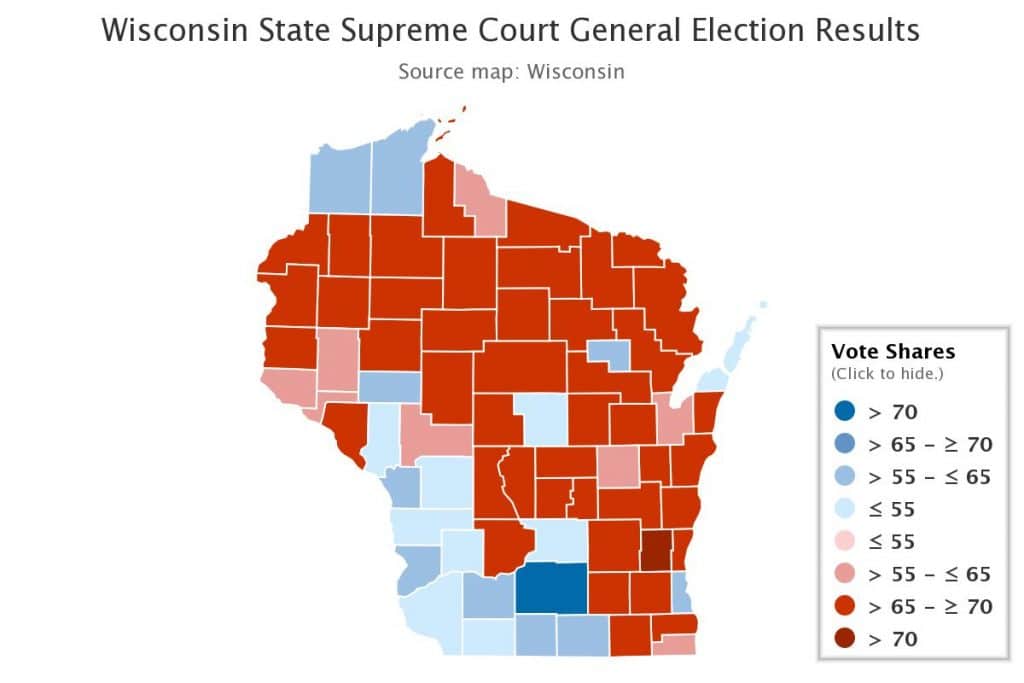
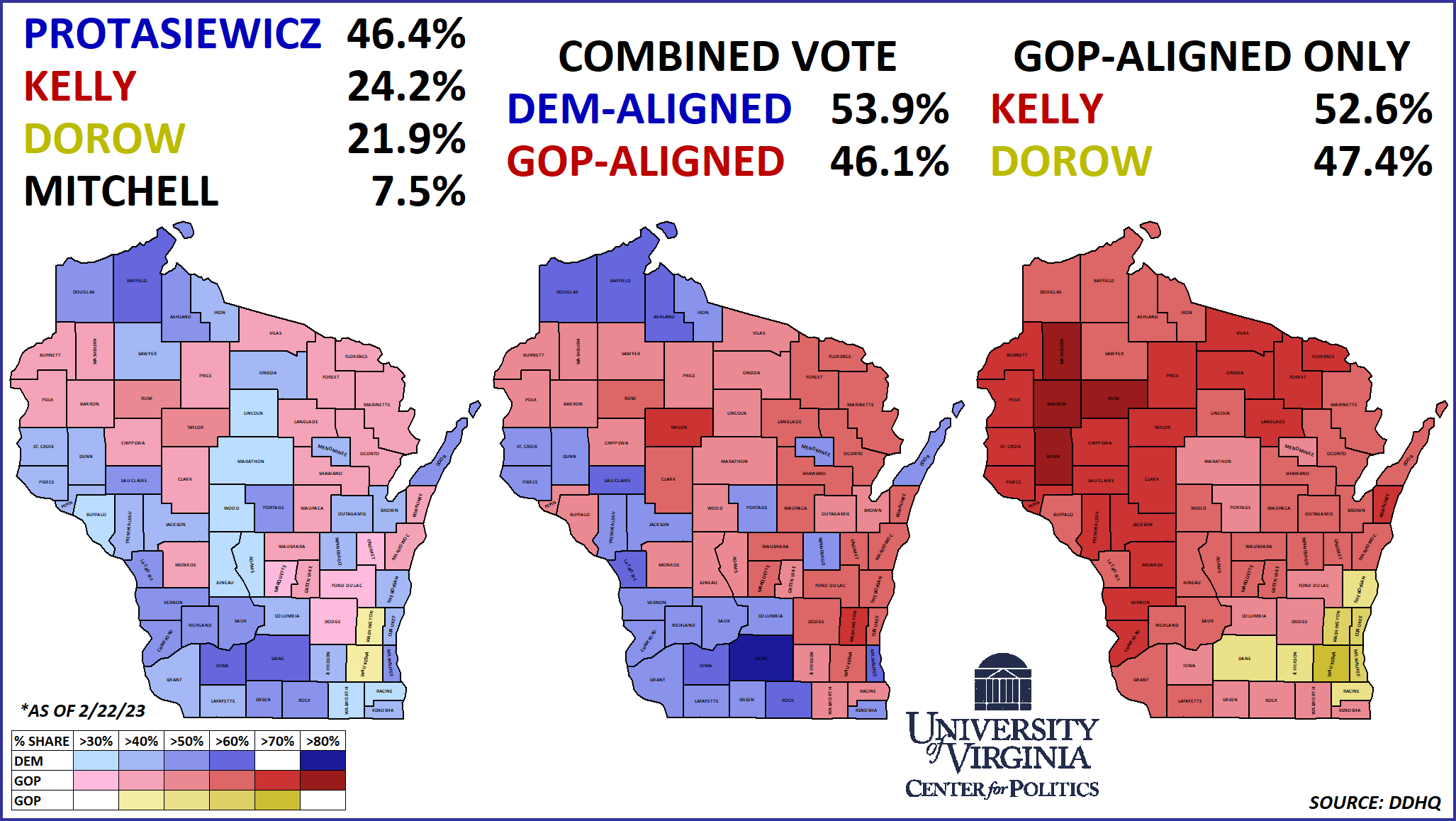
Three of the preceding four Wisconsin Supreme Court elections (2018, 2020, and 2023, with 2019 being the exception) had also seen a liberal defeat a conservative by about 55% to 45%, despite significant variance in overall voter turnout.
See also
- 2025 Wisconsin elections
Notes
Partisan clients
References
External links
- Official campaign websites
- Susan Crawford for Supreme Court
- Brad Schimel for Supreme Court